August 23, 2025
|12 minute read

Your customer’s inbox is crowded. For B2B marketers, it’s the main place where you either get noticed or get deleted in seconds. For a long time, email has been the best way to get a return on your investment (ROI), and it still is—but it’s getting much harder to stand out. Your buyers, from the boss to the IT manager, are overwhelmed with emails. They are quick to delete anything that looks generic, and the old way of sending the same message to big lists of people no longer works. This is where Artificial Intelligence (AI) comes in.
AI in email marketing is about using smart technology to understand your customers on a deeper level and send them emails they actually want to read. Think of it as a very smart assistant for your marketing team. This assistant can look through huge amounts of customer information—like what they’ve clicked on, what they’ve bought, and who they are—to find patterns a person could never see. It then uses what it learns to help you automatically change your message, timing, and content for each individual. It’s the difference between shouting one message to a crowd and having a relevant, personal conversation with each customer, but on a huge scale. This is your simple guide for this new way of doing things. It’s for the B2B marketing leader who needs to make smart tech choices, the marketing strategist doing the day-to-day work, and anyone who knows the future of email isn’t just about automation—it’s about intelligence. Table of Contents
Integrating AI isn’t just about using new technology; it’s about gaining a significant competitive edge. The core advantages are clear, direct, and impact every level of your marketing efforts. 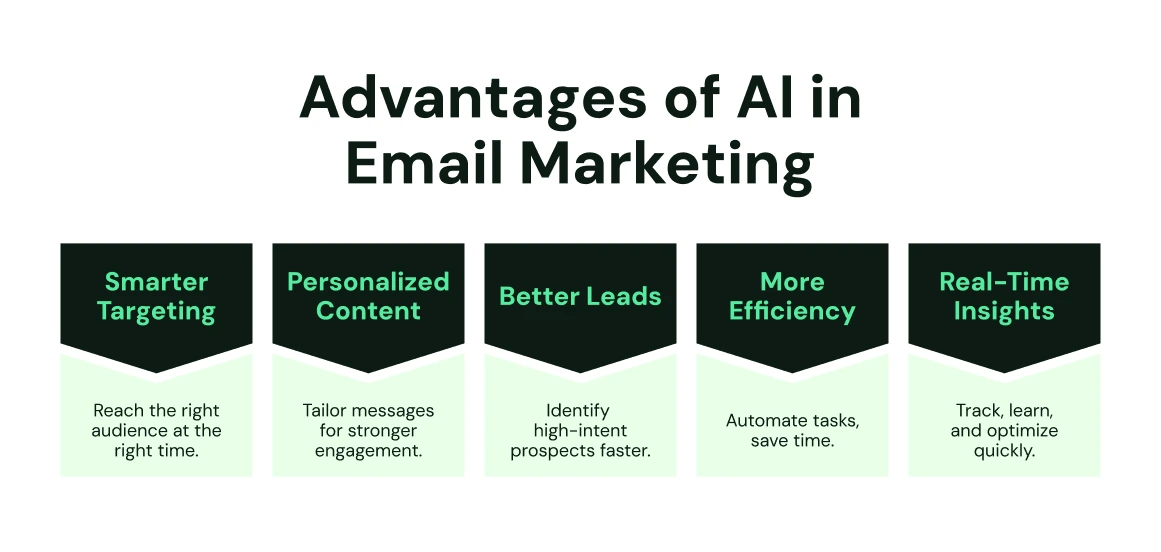 Deeper Customer Connection: AI moves you beyond generic communication. By tailoring content to individual needs and behaviors, you create emails that feel more relevant and personal, strengthening brand loyalty. Higher Quality Leads for Sales: Instead of sending every lead to sales, AI’s predictive scoring identifies who is ready to buy. This means your sales team spends less time chasing dead ends and more time closing deals with high-intent prospects. Increased Team Efficiency: AI automates the most time-consuming parts of email marketing, like list segmentation, A/B testing, and drafting routine copy. This frees your talented team to focus on strategy, creativity, and high-impact projects. Better, Faster Decision Making: AI provides data-backed insights into what’s working and what isn’t. This allows you to stop guessing and start making strategic decisions based on real-time performance data, optimizing your campaigns for success.
AI’s impact isn’t a single feature; it’s a fundamental upgrade to your entire email marketing engine. It’s about moving from educated guesses to data-driven certainty. Let’s dissect the key areas where this transformation is happening.
For a long time, “personalization” just meant adding a person’s first name to an email. That’s the bare minimum now. AI lets you go way beyond that and have real one-to-one conversations..
The old way was to group contacts into broad buckets. The new way is to let AI build dynamic, micro-segments in real time. Instead of just looking at firmographics like company size or industry, AI dives deeper, analyzing a rich tapestry of data points to find patterns you’d never spot on your own (MarTech). This includes: Behavioral Data: Who is clicking on what? Which whitepapers have they downloaded? What pages on your site have they visited? AI connects these dots to reveal true intent. Technographic Data: What technology stack does the target account already use? Knowing they use a competitor’s product or a complementary technology allows for incredibly targeted messaging.
This is where AI’s segmentation power comes to life. Instead of creating a dozen different email versions, you create one smart template. AI then populates that template with the most relevant content for each recipient as they open it (MarTech). Imagine an email sent to multiple stakeholders at a target account:
Please enter your email address so we can send you a one-time pass code and verify if you are an existing subscriber.
 US
US 

 US
US